Boiler Replacement in Coney Island, Brooklyn
When a residential central heating boiler reaches the end of its useful lifespan, continuing to invest in patch repairs becomes an expensive and unpredictable cycle. Multi-family row houses, attached brick dwellings, and residential buildings across Coney Island—along Mermaid Avenue, Neptune Avenue, and Surf Avenue—depend on continuous, heavy-duty heating during punishing winter cold spells. When cast-iron heat exchanger blocks fracture, internal scaling chokes heat transfer, or combustion efficiency plummets, professional boiler replacement restores dependable warmth, structural safety, and lower seasonal operating costs.
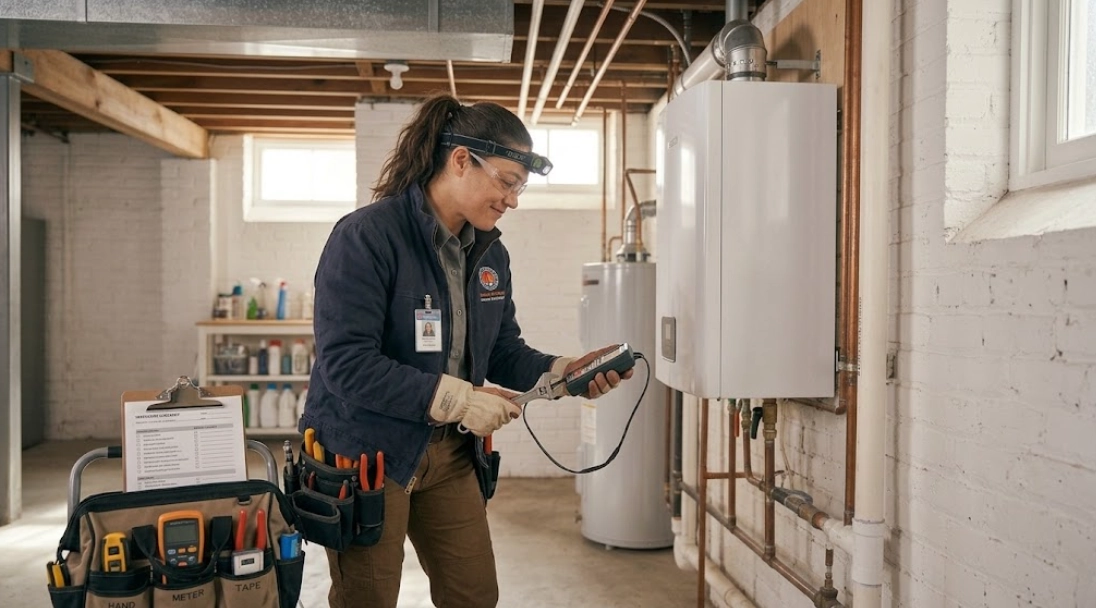
Recognizing When Replacement Outweighs Further Repair
Deciding whether to continue repairing an existing boiler or commit to a complete replacement requires evaluating mechanical condition against long-term reliability. While isolated problems like zone valve heads, aquastats, or circulator relays are routinely repaired on younger systems (as detailed in our boiler repair in Coney Island guide), aging units exhibit unmistakable signs that replacement is the wiser investment:
- Cracked Cast-Iron Vessel Sections: Seepage between cast-iron boiler block sections or through cracked combustion chamber walls cannot be safely welded or patched. Once a pressure vessel is cracked, replacement is mandatory.
- Equipment Age Past 20 to 25 Years: Older atmospheric boilers typically achieve only 60% to 70% annual fuel utilization efficiency (AFUE). Upgrading to a modern modulating-condensing system operating at 90%+ efficiency reduces gas consumption across multi-family properties.
- Chronic Mid-Winter Breakdowns: If you are constantly resetting safety lockouts, experiencing cold radiators across apartments, or calling for emergency repairs during every cold snap, the equipment has reached the end of its reliable operational life.
- Discontinued Replacement Parts: When burner trays, gas valves, or electronic ignition controls for legacy units become obsolete, sourcing parts creates intolerable delays during freezing weather.
Engineering Precision: Sizing vs. the Danger of Oversizing
One of the most damaging misconceptions in heating installation is that installing a larger boiler is automatically better. In reality, oversizing causes severe operational problems:
Hydronic Heating Sizing: In hot-water systems, an oversized boiler heats water far faster than baseboards or radiant loops can absorb it. The burner reaches its high-limit aquastat rapidly and shuts off, only to fire again minutes later. This short-cycling wastes immense fuel, creates severe thermal stress on heat exchangers, and produces wide temperature swings. We perform formal heat-loss calculations accounting for square footage, window surfaces, insulation, and exposure to coastal winds off Gravesend Bay.
Steam System Sizing: In properties equipped with cast-iron steam radiators, the replacement boiler must be sized strictly to the Connected Radiator Load, measured in square feet of Equivalent Direct Radiation (EDR). Undersizing leaves top-floor radiators cold, while oversizing causes high operating pressures, spitting air vents, and violent water hammer. Learn how we balance steam distribution on our steam heat and radiator repair page.
Venting, Chimneys, and Oil-to-Gas Conversions
A successful boiler replacement requires evaluating the entire exhaust and fuel delivery infrastructure:
- Chimney Lining Compatibility: Modern high-efficiency boilers extract more heat from exhaust gases, resulting in cooler flue temperatures with elevated moisture content. Venting into an unlined masonry chimney allows acidic moisture to condense and erode mortar. Upgrades typically require installing a certified stainless steel chimney liner or transitioning to direct-vent polypropylene sidewall piping.
- Oil-to-Gas Conversions: For properties transitioning away from fuel oil, converting to natural gas eliminates fuel deliveries, reduces soot accumulation, and frees valuable basement square footage. We coordinate gas supply pipe load calculations alongside our gas line repair and inspection team.
Permits, Licensing, and Installation Planning
Boiler installations in New York City are strictly governed to protect life safety. Every boiler replacement requires filing formal work permits with the NYC Department of Buildings (DOB). The installation must be executed by or under the direct supervision of an appropriately licensed master plumber. Following installation, gas piping connections and safety controls undergo mandatory high-pressure testing and official DOB sign-off inspections.
What Factors Influence Replacement Scope and Investment?
Without inventing arbitrary pricing, several real-world variables govern the scope and investment required for a Coney Island property:
- Heating Architecture & Capacity: High-efficiency modulating-condensing wall-hung units versus high-mass atmospheric cast-iron boilers differ in equipment cost, venting requirements, and piping complexity.
- Near-Boiler Header Piping: Rebuilding distribution headers, installing primary/secondary pumping loops, updating zone valves, and adding magnetic dirt separators to protect modern heat exchangers.
- Site Accessibility & Heavy Equipment Removal: Rigging out an older 800-pound cast-iron boiler from a tight basement entryway requires specialized equipment and precautions.
- DOB Filing and Gas Utility Coordination: Municipal permit processing, chimney certifications, and National Grid gas service coordination.
Frequently Asked Questions About Boiler Replacement
Oversizing a boiler causes rapid short-cycling, where the burner satisfies the high-limit aquastat too quickly before heat can distribute evenly to distant radiators. This leads to intense thermal stress on the heat exchanger, wasted fuel, noisy operation, and wide temperature swings throughout the building.
A replacement steam boiler must be sized strictly to the Connected Radiator Load, calculated in square feet of Equivalent Direct Radiation (EDR). Undersizing leaves top-floor radiators cold, while oversizing generates excess pressure and banging pipes. Hydronic hot-water boilers, conversely, are sized based on a heat-loss calculation of the building envelope.
Yes. In New York City, installing or replacing a central heating boiler requires formal work permits filed with the NYC Department of Buildings (DOB). All gas piping connections and safety controls must be inspected, pressure tested, and signed off under the supervision of a licensed master plumber.
Modern high-efficiency boilers extract more heat from fuel, producing cooler flue exhaust gases with higher moisture content. Venting into an older unlined masonry chimney allows acidic condensation to erode mortar joints. Upgrades typically require installing a certified stainless steel chimney liner or transitioning to direct-vent polypropylene sidewall piping.