Leak Detection in Coney Island, Brooklyn
Hidden water leaks represent one of the most frustrating and destructive challenges a property owner can face. In attached brick homes, multi-story row houses, and apartment complexes throughout Coney Island—along Mermaid Avenue, Neptune Avenue, and West 19th Street—water lines, hydronic heating loops, and vertical waste stacks are concealed behind plaster, drywall, subflooring, and concrete slabs. Water rarely travels in a straight line; a puddle in a basement or a stain on a first-floor ceiling often originates dozens of feet away. Non-invasive electronic leak detection pinpoints the concealed source without tearing open random walls.
Common Warning Signs of Concealed Plumbing Leaks
Recognizing the subtle warning signs of hidden moisture allows building owners to intervene before structural rot, toxic black mold, or catastrophic ceiling collapses occur:
- Unexplained Spikes in Municipal Water Bills: If your quarterly NYC DEP water utility bill jumps sharply without an increase in household occupancy or fixture usage, pressurized water is continuously escaping somewhere in your plumbing network.
- Persistent Boiler Pressure Loss: In hydronic heating systems, an operating boiler should hold steady pressure (12–15 PSI cold). If your boiler constantly loses pressure, requiring automatic water feeders to add fresh water repeatedly, a pinhole leak exists in an underfloor baseboard run or buried radiant loop. Explore our boiler repair in Coney Island services for heating loop pressure diagnostics.
- Damp Baseboards & Warped Flooring: Hardwood floor cupping, bubbling paint, peeling wallpaper, or dark water stains on sheetrock indicate continuous capillary moisture migration from an adjacent pipe chase.
- Faint Hissing or Running Water Sounds: Hearing the faint sound of running water late at night when all plumbing fixtures and appliances are turned off is a classic sign of an active pressurized pipe fissure.
Non-Invasive Diagnostic Technology
Rather than breaking open plaster walls or tearing up hardwood floors on guesswork, our diagnostic process combines advanced electronic instrumentation:
Infrared Thermal Imaging: High-resolution thermal cameras detect subtle thermal signatures across wall and ceiling surfaces. Hot-water heating pipes and domestic supply lines stand out as vivid thermal tracks; where a leak occurs, escaping hot water blooms into a distinct thermal pattern. Thermal imaging also detects the cooling effect of evaporating moisture from cold-water pipe leaks.
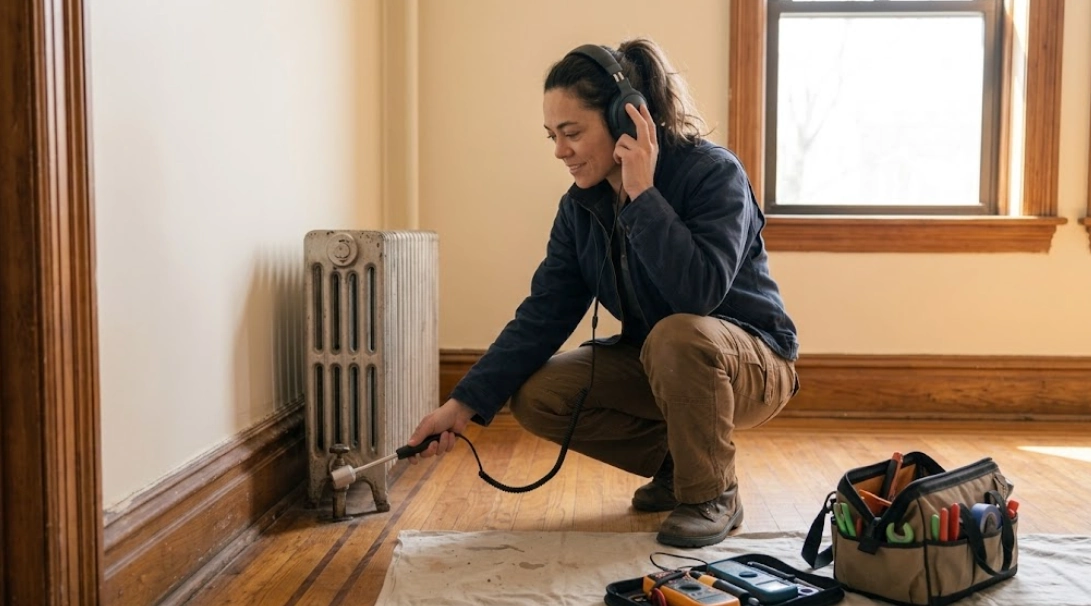
Electronic Acoustic Listening Equipment: Pressurized water escaping through a pinhole fissure in copper, brass, or PEX creates a distinctive high-frequency friction vibration. Using sensitive ground microphones, acoustic listening rods, and digital signal amplifiers, our technicians filter out ambient coastal street noise to isolate the exact source of pipe hiss.
Precision Pressure-Decay Testing: By installing digital test gauges on isolated plumbing sections, we monitor pressure over time. If a pressure decay occurs, we isolate individual fixture risers until the compromised branch is identified.
Realistic Expectations: Pinpointing vs. Physical Repair
Technical Perspective on Non-Invasive Detection
Property owners should understand that while non-invasive diagnostic tools locate the vast majority of concealed leaks within a few inches, no diagnostic technology can physically repair a pipe through a solid wall. Once the leak is electronically pinpointed, a surgical, localized access opening must be made to replace the damaged copper section, solder a new fitting, or repair a connection. Pinpoint detection eliminates exploratory demolition, saving thousands of dollars in wall and floor restoration.
Inter-Apartment Leaks in Multi-Family Buildings
In multi-family residential dwellings common across southern Brooklyn, locating leaks between floors requires distinguishing supply pipe leaks from drainage leaks. Supply leaks drip continuously under 50+ PSI municipal pressure, whereas drain leaks occur intermittently when an upstairs bathtub, shower pan, or washing machine is actively in use. If a main waste line is causing backing up rather than a clean water leak, explore our drain cleaning and sewer line repair services.
Frequently Asked Questions About Leak Detection
We combine thermal imaging infrared cameras (which detect subtle temperature differentials caused by escaping hot or cold water), electronic acoustic listening discs (which amplify the high-frequency sound of pressurized water escaping tiny pipe fissures), and pressure-decay testing on isolated supply lines to isolate the exact leak location before any drywall or flooring is opened.
No honest plumbing professional can guarantee 100% non-invasive detection in every structural scenario. While acoustic and thermal equipment locates the vast majority of leaks with pinpoint accuracy, physical access to the pipe—typically through a small, surgical exploratory opening—is ultimately required to execute the permanent mechanical repair.
Supply and closed hydronic heating lines are under continuous pressure, causing steady, uninterrupted water dripping or rapid pressure drops on the boiler gauge. Drain and waste pipe leaks, conversely, are intermittent, typically dripping only when upstairs plumbing fixtures (such as bathtubs, showers, or washing machines) are actively in use.
An unexplained spike in your quarterly NYC DEP water utility bill almost always indicates continuous subterranean water loss. Common hidden culprits include underground main service pipe cracks, silent running toilet flapper valves, or hidden pinhole leaks in foundation crawlspaces.